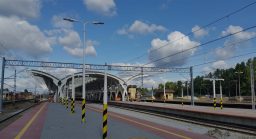
The Challenges Facing Modern Railway Infrastructure
Railway infrastructure components must withstand a wide range of conditions. They are exposed to temperature fluctuations, precipitation, UV radiation, moisture and pollution. Depending on the location, they may also face factors that accelerate corrosion, such as salt exposure or industrial pollutants.
Under these conditions, ensuring adequate structural strength is essential, but so is reducing the need for regular maintenance.
Each maintenance intervention can involve additional costs, technical personnel and careful planning of work around operational railway infrastructure. Choosing durable materials with low maintenance requirements can therefore benefit infrastructure managers and improve the long-term efficiency of an investment.
Why Consider Composite Poles?
Poles made from composite materials, including glass fibre-reinforced polymers (GFRP), offer properties that may meet selected requirements of railway infrastructure.
1. Corrosion Resistance
One of the key advantages of composite materials is their resistance to corrosion. Unlike steel structures, composite poles do not require periodic anti-corrosion treatment to protect the material itself against corrosion.
This can reduce maintenance requirements and the costs associated with keeping structures in good technical condition. It is particularly relevant in locations exposed to moisture, salt or aggressive industrial environments.
2. Resistance to Weather Conditions
Composite poles can be designed for long-term outdoor use. Properly selected materials and structural design can provide resistance to weather conditions and UV radiation.
The performance of any specific solution should, of course, be assessed based on its technical specifications, test results and intended operating conditions.
3. Lower Weight and Easier Installation
Compared with many structures made from traditional materials, composite poles can offer lower weight while meeting the required mechanical performance criteria.
Their lower weight can simplify transport, handling and installation, while potentially reducing the need for heavy equipment. In railway projects, where work organisation and access to installation sites can be particularly challenging, this is an important factor to consider.
The actual benefits depend on the pole’s dimensions, design and the conditions of the project.
4. Electrical Properties
GFRP composite materials are electrically non-conductive compared with metals. This property can be relevant when designing selected railway infrastructure components, particularly in the vicinity of electrical installations.
However, using a composite pole does not, by itself, guarantee the safety of an entire installation. Every solution must meet the requirements applicable to its intended use, while insulation, earthing and protection against electric shock must be assessed in the context of the complete system.
The Purchase Price Is Only Part of the Equation
When selecting infrastructure components, it is worth looking beyond the initial purchase price. Transport, installation, inspections, maintenance and potential repairs over the years of operation are equally important considerations.
This is why whole-life cost analysis is becoming increasingly relevant in infrastructure planning.
A pole that requires less maintenance can help reduce some operating expenses. If its lower weight also simplifies logistics and installation, benefits may arise as early as the construction stage.
The overall cost balance depends on the specific project, the solution selected, environmental conditions and the expected service life. When comparing materials, it is therefore important to consider not only the purchase price but also operational requirements and anticipated maintenance costs.
Composite Poles as Part of Modern Railway Infrastructure
The development of railway infrastructure calls for solutions that combine durability, functionality and efficient use of resources. Composite materials can play an important role in this process, provided they are selected to meet specific technical and operational requirements.
Different applications require different types of structures. Key considerations include operating conditions, required mechanical performance, compliance with relevant standards and the infrastructure manager’s requirements. Composite poles are therefore worth considering at the design stage of new projects or when planning infrastructure upgrades.
NCT – Composite Solutions for the Infrastructure of the Future
At NCT, we develop composite solutions with the needs of modern infrastructure in mind. We believe that choosing the right material means looking beyond the requirements a structure must meet on the day of installation and considering how it will perform over the years to come.
Corrosion resistance, low weight and reduced maintenance requirements make composite poles a solution worth considering for selected railway applications.
Modern infrastructure is not just about what we build today. It is about making informed choices that deliver value for years to come.
Discover the potential of NCT composite technology and explore how it can support the development of railway infrastructure.
