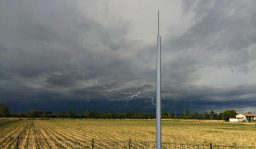
Effective lightning protection is not a single component, but a coordinated system of elements working together to safely capture a lightning discharge and conduct its energy into the ground. Only a complete installation can provide reliable protection for building structures, technical systems, and people inside the facility.
What does a complete lightning protection system consist of?
1. Air terminals
Air terminals are designed to intercept direct lightning strikes. They can take the form of low-level air terminals (conductors or rods) or lightning protection masts equipped with air termination rods.
Lightning protection masts are particularly important where:
- large roof areas require protection,
- technological equipment, photovoltaic systems, or other elements cannot be effectively protected using low-level air terminals,
- required separation distances between the protected object and the lightning protection system must be maintained.
2. Down conductors
The purpose of down conductors is to safely direct lightning current into the ground using the shortest and most direct possible path, without unnecessary bends or loops that could increase the risk of sparking or dangerous overvoltages.
In NCT composite lightning protection masts, the down conductor is routed inside the mast and electrically insulated from the surrounding environment. This provides several important advantages:
- lightning current does not come into contact with the external surface of the mast,
- the risk of side flashes to nearby structures is reduced,
- the safety of people and equipment located near the installation is improved.
3. Earth electrodes
Earth electrodes are responsible for dispersing electrical charge into the ground. Their quality and correct installation are essential for the overall effectiveness of the lightning protection system.
In solutions based on NCT composite masts, the down conductor is routed into the ground through the underground section of the mast, enabling:
- direct and controlled connection to the earthing system,
- fewer connections and fewer potential points of heat generation,
- a high level of safety and long-term installation durability.
Depending on soil conditions, horizontal, vertical, or combined earthing systems can be used.
4. Surge protection devices (SPDs)
Surge protection devices complement the lightning protection system by protecting electrical installations and building electronics against the effects of overvoltages caused by direct lightning strikes as well as nearby lightning events.
Although SPDs are not part of NCT’s product range, it is important to emphasise that modern lightning protection should always be designed as a complete system, including appropriate internal protection measures.
Reliable lightning protection solutions from NCT
Looking for a proven solution to protect your facility against lightning? NCT composite lightning protection masts are a ready-to-install component of a complete lightning protection system, designed to improve installation safety and reliability.
Contact us to learn more about available mast configurations and their possible applications.
