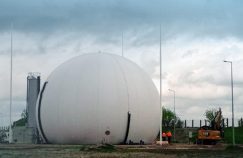
Effective lightning protection is not a single component but a complete system of integrated solutions designed to safely capture lightning strikes and discharge their energy into the ground. Only a properly designed installation provides real protection for building structures, technical systems, and people inside the facility.
What does a complete lightning protection system consist of?
1. Air terminals
Air terminals capture direct lightning strikes. They can take the form of low-level air terminals (wires, rods) or lightning protection masts with air rods.
Lightning protection masts are particularly important where:
- large roof areas need to be protected,
- technological equipment, PV installations, or elements that cannot be effectively protected with low-level air terminals are present,
- required separation distances from protected structures must be maintained.
2. Down conductors
The role of down conductors is to safely direct lightning current to the ground through the shortest and most direct route, avoiding unnecessary bends and loops that could cause sparking or overvoltages.
In NCT composite lightning protection masts, the down conductor is routed inside the mast and insulated from the surrounding environment. This ensures that:
- lightning current does not come into contact with the mast surface,
- the risk of flashovers to nearby elements is reduced,
- the safety of people and equipment located near the installation is improved.
3. Earth electrodes
Earth electrodes are responsible for dispersing electrical charge into the ground. Their quality and correct installation are crucial for the effectiveness of the entire lightning protection system.
In solutions based on NCT masts, the down conductor is extended into the ground through the underground section of the mast, enabling:
- direct and controlled connection to the earthing system,
- fewer connections and potential heating points,
- high levels of safety and long-term durability.
Depending on soil conditions, horizontal, vertical, or combined earthing systems are used.
4. Surge protective devices (SPD)
Surge protective devices complement lightning protection by protecting electrical installations and building electronics against the effects of surges caused by both direct lightning strikes and nearby discharges.
Although SPDs are not part of NCT’s product range, it is important to emphasise that modern lightning protection should be designed as a complete system, including appropriate internal protection measures.
Lightning protection in 2026 – regulations and standards
Regulations and standards applicable in 2026 clearly define when lightning protection systems are required. This applies, among others, to:
- buildings over 15 m high,
- structures and facilities exceeding 35 m,
- facilities with explosion-risk areas,
- buildings with photovoltaic installations above 10 kW,
- petrol stations, halls, and facilities designed for more than 500 people,
- masts and supporting structures of technical infrastructure.
Lightning protection systems must be inspected:
- at least once every 5 years,
- every 12 months in high-risk facilities.
The lack of a required installation or failure to meet applicable standards may result in administrative penalties.
NCT products and compliance with standards
NCT composite lightning protection masts are designed and manufactured in accordance with current standards:
- PN-EN 62305-1:2011 – lightning protection – general principles,
- PN-EN 62561-1:2012 – requirements for connection components of lightning protection systems,
- PN-EN 62561-2:2012 – requirements for conductors and earth electrodes.
This provides designers, contractors, and investors with confidence that the solutions comply with applicable requirements.
Looking for a reliable lightning protection solution?
NCT composite lightning protection masts are a ready-to-use component of a lightning protection system that enhances installation safety. Contact us to learn more about available mast variants and their applications.
