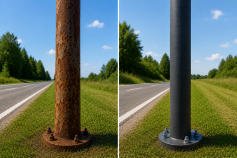
High temperatures are becoming an increasing challenge not only for people but also for infrastructure. Lighting poles, power poles and telecommunication poles are exposed for many years to solar radiation, heating, moisture, precipitation and rapid temperature changes.
However, the durability of a structure is not determined by a single hot day. The greatest impact comes from thousands of heating and cooling cycles that the material must withstand throughout its entire service life.
How do steel poles and composite poles perform under such conditions?
The surface temperature of a pole can be much higher than the air temperature
When air temperatures exceed 30–35°C, the surface of a pole directly exposed to sunlight can become significantly hotter.
The behaviour of a structure is influenced by factors such as:
- colour and type of surface finish,
- solar radiation intensity,
- thermal conductivity of the material,
- exposure time,
- local weather conditions.
Therefore, when assessing pole durability, it is important to analyse not only temperature but also how the material reacts to long-term environmental exposure.
Steel poles – durability depends on corrosion protection
Steel has high thermal conductivity, which means it heats up quickly and transfers heat throughout the entire structure.
Under temperature changes, steel naturally expands and contracts. Heat alone does not cause a steel pole to lose its load-bearing capacity, but long-term environmental exposure can affect its durability.
The greatest challenge remains corrosion.
A combination of moisture, UV radiation, precipitation, pollutants and mechanical damage can lead to the degradation of protective coatings. In such cases, the following may be required:
- inspections,
- repairs,
- renewal of protective coatings,
- additional maintenance work.
This means that the operating cost of a steel pole includes not only purchase and installation, but also future maintenance.
Composite poles – lower heat transfer and no corrosion
Composite materials, such as GFRP (glass fibre reinforced polymer), behave differently from steel.
Due to their lower thermal conductivity, heat does not spread through the structure as quickly. This can be particularly important for poles equipped with:
- electrical installations,
- cameras,
- sensors,
- telecommunication devices,
- Smart City solutions.
One of the most important advantages of composites is resistance to electrochemical corrosion.
Composite poles do not require galvanizing or periodic renewal of anti-corrosion coatings, which is especially important in demanding environments such as:
- coastal areas,
- roads exposed to salt,
- industrial zones,
- locations with high humidity.
Of course, composite structures also require technical inspections, especially after mechanical damage or extreme weather events.
UV radiation and manufacturing technology matter
UV radiation affects all outdoor materials.
For composites, the quality of the resin system and the external protective layer play a key role in protecting the structure against radiation, moisture and material ageing.
Therefore, when choosing a pole, it is important to consider not only the material itself but also:
- manufacturing technology,
- quality of production,
- technical documentation,
- verified performance parameters.
Steel and composite – key differences
| Area | Steel pole | Composite pole |
|---|---|---|
| Thermal conductivity | High | Significantly lower |
| Temperature response | Expansion and contraction of steel | Depends on laminate structure |
| Corrosion | Requires protection | No electrochemical corrosion |
| Maintenance | Possible coating renewal | Limited maintenance requirements |
| Weight | Higher | Significantly lower |
The entire service life matters
The biggest challenge for infrastructure is not one exceptionally hot day. It is years of exposure to sunlight, moisture, frost, road salt and changing temperatures.
Steel remains a proven material; however, it requires effective corrosion protection and consideration of future maintenance costs.
Composite materials offer a different approach – low weight, corrosion resistance and different thermal properties can contribute to easier operation and reduced costs throughout the entire life cycle of infrastructure.
Heat passes. The effects of long-term exposure remain.
