In Poland, as in many countries around the world, the number of people choosing electric vehicles continues to grow. As a result, the demand for charging infrastructure is increasing rapidly, creating significant challenges for property owners, investors and local authorities. These challenges are further intensified by new legislation. From 1 January 2025, regulations introducing mandatory EV charging infrastructure requirements for certain non-residential buildings will come into force. What does this mean in practice?
From January 2025, owners and managers of non-residential buildings with at least 20 parking spaces will be required to comply with new regulations.
For existing non-residential buildings, owners or facility managers must:
- install at least one electric vehicle charging point;
- provide cable ducting and electrical infrastructure enabling the future installation of charging points for at least one in every five parking spaces.
For newly constructed non-residential buildings with at least 11 parking spaces, investors must:
- install at least one charging point;
- provide infrastructure enabling the installation of charging points for at least one in every five parking spaces.
EV Charging Stations in Residential Areas and Car Parks – Limited Space and High Costs
Meeting these requirements can be challenging in many locations due to the lack of available space for traditional charging stations. Expanding parking infrastructure often involves significant costs as well as complex spatial planning considerations.
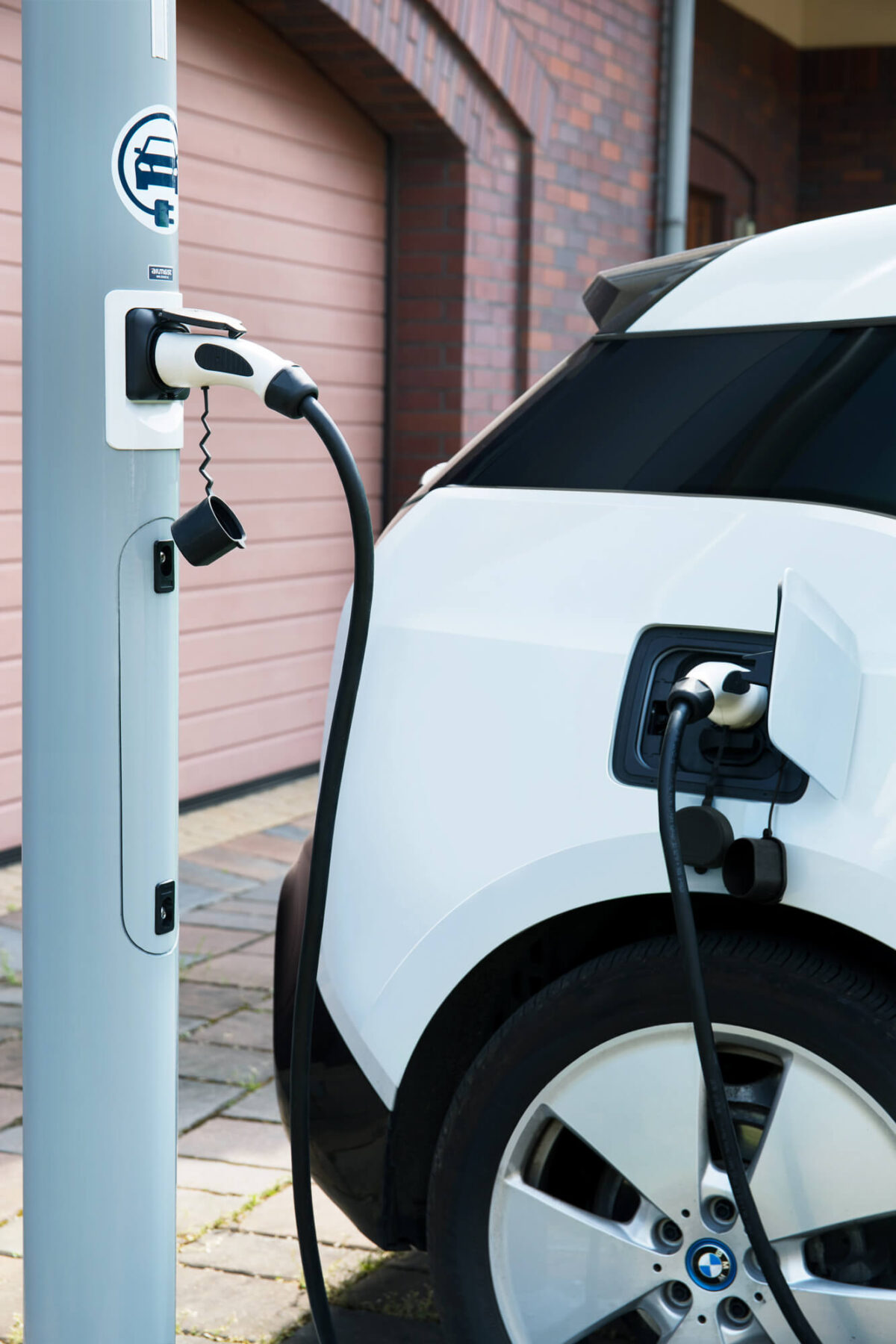
In densely populated urban areas, where every square metre of space is valuable, finding suitable locations for charging stations can be particularly difficult. In such cases, charging stations integrated into lighting columns provide an effective and practical solution.
Why Charging Stations Integrated into Lighting Columns?
Charging stations built directly into lighting columns offer a range of advantages that make them ideal for urban and residential environments.
Space Saving
Integrated charging stations require no additional space, as they utilise existing lighting infrastructure. This means they do not reduce the number of parking spaces available or obstruct pedestrian walkways.
Lower Investment Costs
Where existing lighting columns are approaching the end of their service life and require replacement, the upgrade can be combined with the installation of lighting columns equipped with EV charging stations. This approach reduces overall investment costs while making use of existing electrical connections and infrastructure.
Versatility and Convenience
Charging stations integrated into lighting columns can be installed in a wide variety of locations, including:
- public car parks;
- city centres;
- office developments;
- residential estates;
- shopping centres.
They are particularly useful in places where people spend extended periods of time, allowing vehicles to be charged while drivers work, shop or attend other activities.
Advanced Charging Technology
Lighting columns equipped with integrated charging stations can offer:
- charging capacities of 1 or 2 × 7.4 kW and 1 or 2 × 22 kW;
- charging currents of up to 32 A;
- single-phase or three-phase power supply;
- user authentication via RFID card or mobile application;
- overcurrent and Type B residual current protection;
- MID-certified energy meters for accurate energy measurement.
The systems also feature IK10 impact resistance and IP44 protection rating
Composite Lighting Columns – A Modern and Practical Solution for Cities
Composite lighting columns are an innovative infrastructure solution that is gaining popularity thanks to their unique performance characteristics. Composite materials are lightweight, durable and corrosion-resistant, making them ideal for urban applications.
As composites are electrically non-conductive, they provide a high level of safety for both users and the electronic equipment installed within the columns. This is particularly important when integrating electrical charging systems into public infrastructure.
Composite lighting columns also provide an excellent platform for integrating additional technologies, including:
- warning systems for pedestrian crossings and road safety applications;
- radio transmitters and communication equipment;
- sensors and monitoring systems supporting smart city management.
Their versatility and ability to integrate multiple technologies make them not only a practical solution but also a future-proof investment. Composite columns can combine public lighting, electric vehicle charging and intelligent infrastructure functions within a single structure, helping cities become safer, more efficient and more sustainable.
Discover NCT Solutions