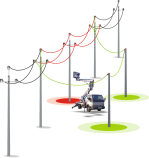
As power distribution networks become increasingly complex, utilities face growing demands for reliability, operational flexibility, and uninterrupted electricity supply. One solution that effectively addresses these challenges is the mobile service line—a temporary overhead line system designed to maintain power supply during maintenance, upgrades, or emergency situations.
A practical solution for temporary power distribution
A mobile service line is a temporary overhead power line typically used in low-voltage (LV) and medium-voltage (MV) distribution networks. The system is built around lightweight, modular composite poles, approximately nine metres in height, allowing for easy transportation and rapid deployment in the field.
Its primary purpose is to create a temporary bypass around a damaged or isolated section of the network. This enables electricity to be rerouted while maintenance or repair work is carried out, eliminating the need for prolonged outages.
Maintaining uninterrupted power supply
One of the key advantages of a mobile service line is its ability to significantly reduce power interruptions. In many cases, customers experience only a brief interruption during the transfer of the power supply, while electricity remains available throughout the maintenance or repair process.
This allows utilities to perform essential work safely and efficiently without compromising service continuity.
Typical applications
Mobile service lines are widely used by distribution system operators in a variety of situations, including:
- Emergency restoration following network failures
- Maintenance, refurbishment, and reconstruction of overhead lines
- Temporary power supply for construction sites
- Temporary lighting installations in outdoor work areas
Their versatility makes them an important asset for utilities that require fast, flexible solutions to maintain network availability.
Benefits for distribution system operators
For distribution system operators (DSOs), mobile service lines provide measurable operational and financial benefits.
By minimising customer outages, they help improve key network reliability indicators such as SAIDI (System Average Interruption Duration Index) and SAIFI (System Average Interruption Frequency Index), which are widely used to assess power supply performance.
They also reduce the costs associated with service interruptions, minimise the risk of regulatory penalties, and contribute to improved operational efficiency and customer satisfaction.
Technical advantages
Mobile service line systems offer several important technical benefits:
- Fast and straightforward installation for rapid emergency response
- No permanent ground foundations or excavation required, reducing installation time and permitting requirements
- Lower operating costs compared with alternative temporary power solutions, such as diesel generators
- Lightweight, highly mobile components that can be deployed and reused multiple times
The use of composite structural elements further enhances durability, corrosion resistance, and long-term performance in demanding environmental conditions.
A modern approach to network resilience
Mobile service lines have become an essential part of modern power distribution infrastructure. Their mobility, reliability, and cost-effectiveness enable utilities to maintain continuity of supply even under the most challenging operating conditions.
As customer expectations continue to rise and regulatory requirements become increasingly stringent, solutions such as mobile service lines are no longer simply an operational advantage—they are becoming a standard component of resilient and future-ready electricity networks.
